

Hot Press News
- Tech Mahindra Launches Engineering Experience Centre to Empower Engineering Organizations Turn Ideas into Impact Faster
- Fairmont Jaipur Welcomes the Season with 'The Grand Monsoon Escape'
- DataVare Launches PST to EML Converter Expert, Streamlining Outlook Migration to Thunderbird, Apple Mail, and More
- Kailash Deepak Hospital, Delhi Organizes Free Mega Health Check-up Camp & Health Awareness Programme
- Garage Door Repair Fast Announces New Standards for Precision Garage Solutions For Every Windermere Residential Property
- Toronto Roofing Contractor Expands Emergency Roof Repair Response Times
- ESET Threat Report H1 2026 Reveals QR code phishing Emerges as the No. 2 Email Threat in India
- Xpress Health Australia Expands Operations to Address Growing Demand for Nursing and Healthcare Jobs in Sydney
- AmpleLogic Introduces Advanced Document Control Software to Simplify Compliance for Regulated Industries
- Toronto Family Law Firm Expands Access to Mediation Services
- DRS Softech Releases Secure Office 365 Tenant to Tenant Migration Solution for Microsoft 365 Environments
- CEP IIT Delhi Opens Admissions for Chief Technology Officer Programme
- Cigati Solutions Introduces PST Converter to Simplify Outlook Email Conversion, Backup, and Cloud Migration
- Prof. Man Mohan Sharma Honored with Vigyan Maharshi Award as NSRTC 2026 Concludes at MIT-WPU
- Cisdem Debuts AI-Powered Duplicate Finder 5 with Meta's DINOv2
 Mail to a Friend Mail to a Friend |
|
 Rate Rate |
 |
ESET Threat Report H1 2026 Reveals QR code phishing Emerges as the No. 2 Email Threat in India
2026-07-28 01:33:42
Technology
175
New Delhi, July 28, 2026: ESET Research has released its H1 2026 Threat Report, which summarizes threat landscape trends seen in ESET telemetry, as well as insights from ESET threat detection and research experts, from December 2025 through May 2026. The first half of 2026 shows how attackers continue to improve the efficiency and scalability of their operations. Artificial intelligence (AI) is playing a growing role in this development. ESET analyzed nearly 900,000 AI skills and small functional components used by AI agents and identified tens of thousands of suspicious and thousands of outright malicious instances. AI is also beginning to appear within malware itself: ESET researchers have identified PromptSpy, the first known Android malware to use generative AI in its execution flow.
India Snapshot: Key findings from ESET's H1 2026 telemetry
● Quishing on the rise: QRCode/Phishing trojan was India's second most-detected email threat in H1 2026, accounting for roughly 7.4% of all malicious email detections in the country and placed among India's top 10 malware detections overall (~2.5% share
● Loan-scam apps lead Android threats: Android/SpyLoan PUA - malicious loan apps that harvest personal data and enable harassment/extortion of borrowers was India's most-detected Android threat (~24.5% of Android detections), ahead of Android/TrojanDropper.Agent trojan, which tops the global Android rankings but ranks second in India (~23.1%).
● A different ransomware leader: Python/Filecoder trojan was the most-detected ransomware family in India (25% share) well ahead of Win/RiskWare.LockScreen application, which is the most detected ransomware detected globally
● Familiar phishing, local flavor: JS/Agent trojan was India's most-detected overall threat (11.2%), while HTML/Phishing.Agent trojan the No. 1 threat worldwide ranked second in India (9.1%).
Global highlights from the H1 2026 Threat Report
"Rather than relying on entirely new methods and tools, attackers are quickly adapting established techniques to new platforms, technologies, and user behaviors. The number of AI skills within this new ecosystem is growing rapidly as we speak, further expanding the attack surface," says ESET Director of Threat Prevention Labs Jiří Kropáč. "On the other hand, PromptSpy illustrates the potential for increased flexibility in future threats – although guardrails against abuse included in LLMs are likely slowing down the adoption," explains Kropáč.
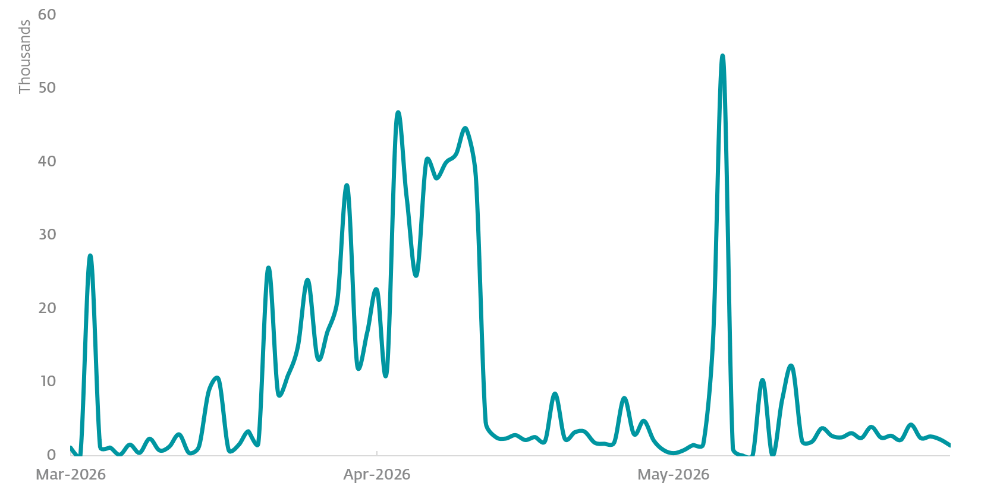
AI skills are small add-ons or sets of instructions that instruct an AI agent how to perform a specific task, including which services or tools to use and what data to access. The published report covers details about malicious AI skills using third-party hacking tools such as Mimikatz or Impacket and a suspicious self-modifying skill designed to create a persistence mechanism and a tool for self-modification. This can lead to unpredictable behavior of the agent or its abuse by an attacker. QR code phishing also known as quishing has reached record levels in ESET telemetry, with attackers embedding malicious links in QR codes to bypass inspection and shift user interaction to mobile devices while exploiting the implicit trust many people place in the barcodes with square patterns. Approximately 11% of all detected phishing emails in H1 2026 utilized QR codes, and QR code phishing threats were most prevalent in the US (19% of detections), Spain (17%), and Mexico (6%).
India mirrors this trend closely: QR code phishing was India's second most-detected email threat category in the same period, underscoring the need for Indian enterprises and consumers alike to "stop before they scan."
Meanwhile, ClickFix – a social engineering technique leveraging fake error messages – has expanded beyond fake CAPTCHA prompts into AI-themed help pages, browser extensions, and cloud authentication scenarios. AI-fix shows how adversaries exploit trust in generative AI, embedding ClickFix compromise chains into AI-generated troubleshooting content to nonexistent issues on pages that abuse domains of AI powerhouses. ConsentFix highlights an evolution toward token theft, combining ClickFix-style interaction with OAuth authorization abuse to hijack cloud accounts without the need to steal credentials, often bypassing MFA and relying entirely on legitimate login workflows. ESET detections of this vector more than doubled between H2 2025 and H1 2026, indicating sustained activity and adaptation.
Phishing campaigns are also evolving in response to user behavior. QR code phishing – also known as quishing – has reached record levels in ESET telemetry, with attackers embedding malicious links in QR codes to bypass inspection and shift user interaction to mobile devices while exploiting the implicit trust many people place in the barcodes with square patterns. Approximately 11% of all detected phishing emails in H1 2026 utilized QR codes, and QR code phishing threats were most prevalent in the US (19% of detections), Spain (17%), and Mexico (6%).
Last but not least, ransomware activity showed no signs of slowing down, with the continued use of EDR killers – tools designed to disable security software during attacks. ESET Research has documented over 100 different EDR killers used in the wild, with new variants appearing regularly. The number of ransomware attacks continued to grow in H1 2026, but the number of victims willing to pay reached all-time lows. Three recent industry reports confirmed this downward trend, reporting a 14–28% share of paying victims.
About ESET
ESET® provides cutting-edge cybersecurity to prevent attacks before they happen. By combining the power of AI and human expertise, ESET stays ahead of emerging global cyberthreats, both known and unknown — securing businesses, critical infrastructure, and individuals. Whether it's endpoint, cloud, or mobile protection, our AI-native, cloud-first solutions and services remain highly effective and easy to use. ESET technology includes robust detection and response, ultra-secure encryption, and multifactor authentication. With 24/7 real-time defense and strong local support, we keep users safe and businesses running without interruption. The ever-evolving digital landscape demands a progressive approach to security: ESET is committed to world-class research and powerful threat intelligence, backed by R&D centers and a strong global partner network.
Company :-Evoc Communications
User :- Maroof Qureshi
Email :-maroofq@evoc.in

_thumb.png)
To ensure stability and reachability of your applications at all times, remote DDoS protection can keep your hosting services online



Get your Explainer Video at 100 dollars only Today.