

Hot Press News
- Waterproofing Contractors in Cape Town: Property Owners Urged to Inspect Before Winter Rain
- Racold unveils Titanium Ultracore Technology engineered to enhance water heater durability
- ECS Management to Expand Driveway Installation and Concrete Solutions to More Cities as Demand Surges
- Amazon Collaborates with Tata Motors to Deploy 3,000 Electric Trucks in Its Transportation Network in India
- Swiggy renews comprehensive Insurance Programme for its delivery partners with IndusInd General Insurance
- V-Xpress Strengthens Appointment Delivery for Quick Commerce Growth with a 90%+ Service Level
- DDReg Pharma Wins ‘Entrepreneur of the Year in Service Business’ at Entrepreneur India Awards 2026
- Delhi High Court Upholds Relief to SSC Candidate Over Non-Supply of CCTV Footage
- VAADA Establishes a First-of-Its-Kind Foster Home for Six Girl Children
- New analysis from International Workplace Group and Arup finds Hybrid working is now the key talent advantage for HR leaders
- Spyne survey reveals 90% of used-car dealers surveyed do not use a CRM to store leads
- Shankar Fenestrations and Glasses Expands Its Project Portfolio with CRC The Flagship
- Dr. Sandeep Marwah Honoured with Prestigious MSME Award in New Delhi
- John Crane strengthens reliability at phosphate mining and processing operations
- Ganesh Spices Launches ‘Pure Masala. Sure Swaad.’ Campaign Featuring Actors Parambrata Chattopadhyay and Raima Sen
 Mail to a Friend Mail to a Friend |
|
 Rate Rate |
 |
Intel Uses AI to Let the Visually Impaired "See" the World
2026-10-27 12:38:03
Technology
807
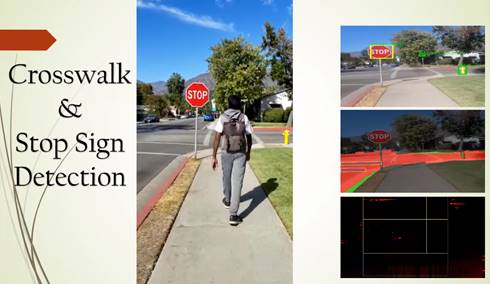
Artificial intelligence (AI) developer Jagadish K. Mahendran and his team have designed a voice-activated backpack powered by artificial intelligence that can help visually impaired people navigate and perceive the road. This backpack can help detect some common roadblocks, such as traffic lights, hanging obstacles, pedestrian crossing, moving objects and up and down slopes. The calculations for these detections are all run on a low-power interactive device.
"Last year, I met a visually impaired friend, and then I found the irony is that when I have been training robots to see things, many people can not see things and need help. This inspired me built this visual aid system, using Intel?s OpenCV Artificial Intelligence Toolkit (OAK-D)".
?Jagadish K. Mahendran, Institute of Artificial Intelligence, University of Georgia
According to the World Health Organization, there are 285 million visually impaired people in the world. At the same time, the visual assistance systems that help them travel are currently very limited. From GPS-based voice-assisted smartphone applications to smart crutches equipped with cameras, these devices and systems that can be used for the visually impaired are not only very limited. There is also a lack of depth perception ability, and this function is very necessary for the visually impaired to travel independently.
Hema Chamraj, Director of Intel?s Technical Advocacy and AI4Good Department, said: ?We have seen this developer use Intel?s artificial intelligence technology at the edge to develop such a solution so quickly, which has helped these visually impaired friends get a more convenient life. This is incredible. Now that we have such a technology, we need the imagination of the developer community to further develop this technology."
Jagadish K. Mahendran modeled his artificial intelligence-driven voice-activated backpack, which can help visually impaired people navigate and perceive the world around them.
Working Principle
This system is located in a small backpack, which contains a host computing device, like a laptop. The camera is hidden in the vest jacket, and a pocket-sized battery pack is placed in the waist bag, which can provide power for about 8 hours of use. A Luxonis OAK-D space artificial intelligence camera can be attached to the vest or waist bag, and then connected to the computing device in the backpack. There are three small holes on the vest for the OAK-D camera, and the camera is located on the inside of the vest.
Brandon Gilles, founder and CEO of Luxonis, said: "Luxonis' mission is to enable engineers to develop things that are meaningful to people and to help them quickly use Intel?s artificial intelligence technology. It?s great to see someone in such a short time use OAK-D to develop extraordinary equipment such as artificial intelligence-powered backpacks."
This OAK-D device is a powerful multi-functional artificial intelligence device that uses Intel Movidius VPU and Intel OpenVINO toolkit for on-chip edge artificial intelligence reasoning. It can run advanced neural networks while providing accelerated computer vision functions and real-time depth maps from its stereo pairs, as well as color information from a 4K camera.
With a Bluetooth headset, users can use the system through voice commands, and the system will respond with voice. As users move around, the system will voice information about common obstacles, including signal lights, tree branches, and pedestrians. It can also remind you that there are intersections, curbs, stairs and entrances ahead.
User :- Rachel Ye
Email :-fadjdagd@gmail.com
Url :- https://www.apogeeweb.net/industry-news/intel-uses-ai-to-help-visually-impaired.html




Get your Explainer Video at 100 dollars only Today.

To ensure stability and reachability of your applications at all times, remote DDoS protection can keep your hosting services online