
Hot Press News
- ECO Mobility Highlights Growing Opportunity for International Self-Drive Road Trips
- BoneBox Introduces a Thoughtful Approach to Pet Products, Putting Quality and Transparency First
- MIT-WPU Students Develop Living Façade System Using Algae and Cyanobacteria to Explore Passive Cooling for Indian Buildings
- CEng. Shreekant Patil Selected as Candidate Among 18 Council Seats for the Europeana Members Council Elections
- On World Toilet Day, Reckitt and IIPS Release Landmark Study on Bridging the Life-Expectancy Gap of India’s Sanitation Workers
- Niral Networks Showcases Edge AI, Intelligent 5G and Physical AI at Qualcomm Innovation Forum 2026
- Falcon Gallant Prepares Branded Confectionery Supply for Spain’s Christmas and Reyes Season
- Noida gets a new address for eating out with Atria by Sovereign
- Honda Motorcycle & Scooter India Announces Prices for Rebel 500
- Shamil Translation Highlights the Importance of Accurate Document Translation for Bahrain Residents and Businesses
- Kia Carens Clavis CNG and Carens CNG Cross 6,200 Wholesale Units, Reflecting Growing Preference for CNG Mobility
- Recrui8 Expands HR Recruitment Services in Pune to Help Businesses Hire Faster and Smarter
- ReadyBid Spotlights Robotics and Industrial Automation as a New Frontier for Corporate Hotel Sourcing
- Bilston Recovery Firm Outlines Vehicle Auction Transport West Midlands Service for Buyers and Dealers
- IBM and Axis Max Life Insurance Collaborate to Strengthen Database Security Across Hybrid Cloud Environments
 Mail to a Friend |
|
 Rate |
 |
MIT-WPU Students Develop Living Façade System Using Algae and Cyanobacteria to Explore Passive Cooling for Indian Buildings
2026-11-19 09:10:32
Design
246
Mumbai/Pune: As Indian cities grapple with rising temperatures and increasing urban heat, a team of students from MIT World Peace University (MIT-WPU) came up with an innovative approach to passive cooling – using living biological surfaces on building façades.
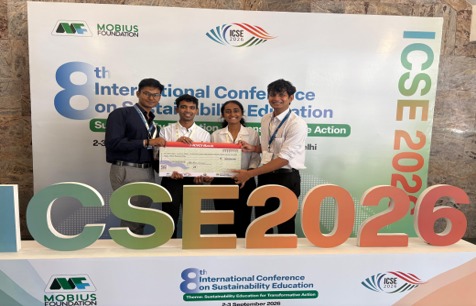
The project, titled Bioreceptive Façade System for Passive Cooling in Indian Climates, was named a winner of the Youth for Earth (Y4E) Campaign 2026, organised by the Mobius Foundation and The Climate Reality Project. The team was recognised at the 8th International Conference on Sustainability Education (ICSE) 2026, held recently at the India Habitat Centre, New Delhi.
The interdisciplinary team comprises four final-year B.Tech students from the Department of Bioengineering and two students from the Department of Computer Science and Engineering (CSE), worked under faculty guidance.
Unlike conventional green walls that require soil and irrigation infrastructure, bioreceptive façades use specially engineered coatings that act as growing surfaces for moss, algae and cyanobacteria. These biological layers can help cool buildings through two mechanisms: evapotranspiration, which draws heat away from surfaces through water evaporation, and solar shading, which reduces direct sunlight reaching the building.
Research conducted in temperate regions such as the Netherlands and Belgium has reported surface temperature reductions of up to 30°C using similar systems. The MIT-WPU team explored how this technology can be adapted to Indias hotter and more variable climatic conditions.
The students designed and developed a porous coating using locally available materials, including recycled brick powder, silica fume, expanded clay and kaolin. Their work also involves identifying heat-tolerant Indian algae and moss species, developing a carrageenan-based bio-gel for biological growth and assessing the coatings thermal performance and durability.
Initially the team developed a prototype comprising a five-brick clay wall section with a 10 mm cement base, coated with locally sourced green algae and Chlorella vulgaris. The north-facing prototype was monitored twice a week between June 7 and July 7, 2026, with readings compared against an identical cement-coated wall without biological growth. The observation period captured both pre-monsoon and monsoon conditions.
Dr. Sharbani Kaushik, Program Director, Department of Bioengineering, School of Engineering and Technology, MIT-WPU, and mentor of the project, said, Algae and cyanobacteria use sunlight and carbon dioxide to manufacture their own food, making them interesting candidates for sustainable building coatings. Our focus is to identify species and materials that can withstand Indian climatic conditions and explore how biological systems can help make buildings more climate-responsive.
Dr. Sheetal Kulkarni, Assistant Professor, Department of Computer Science and Engineering Technology, MIT-WPU, and mentor of the project, said, The project has given students from different disciplines an opportunity to work together on a real-world challenge. By combining bioengineering with application development and real-time data display, they are exploring how technology and biological systems can work together to develop practical solutions.
The project aims to contribute to urban heat mitigation, reduced dependence on mechanical cooling, carbon reduction and urban biodiversity. The team is also exploring the systems long-term durability, performance across different building orientations and its potential alignment with India's National Building Code and GRIHA green building framework.
Company :-Dentsu
User :- Nitin Jaitapkar
Email :-Nitin.Jaitapkar@dentsu.com
Other articles by MIT-WPU


To ensure stability and reachability of your applications at all times, remote DDoS protection can keep your hosting services online

Get your Explainer Video at 100 dollars only Today.