

Hot Press News
- FADA Academy and ASDC Inaugurate Their First Joint Training Centre at Agra to Build a Job-Ready Automotive Retail Workforce
- ReadyBid Unlocks Hotel Sourcing Opportunities Across Franchise Networks
- Smart Electricity Meter in India Crosses 7.24 Crore Installations as Prepaid Metering Reshapes Power Distribution Nationwide
- Amaha Mental Health Report 2026 Reveals 53% of Those Seeking Mental Healthcare Waited Over a Year
- Aksha Kamboj Honours Aman Sehrawat for His Historic Asian Games Gold Medal Win
- Bee Moments N Experience Introduces Event Planning Services for Manchester Celebrations
- ODM Public School Hosts Career Fair 2026, Opening Real-World Pathways for Students
- Imarticus Learning’s Future Skills for Bharat Launched in Association with IIT Kanpur
- HDFC Bank Launches Festive Treats 2026 – with over 10,000 Exciting Offers
- Apzix Brings Custom Binary Options Platform Script Solutions to Fintech Startups and Enterprises
- IDS Next Expands Wellness Technology Offering Through Oracle Marketplace
- Pulse Ka Pandal 2026 Brings Immersive Digital Experiences to Navratri, Durga Puja and Dussehra
- Matrix and Veracity Integrate Video Surveillance with VIEWSCAPE Command & Control Platform
- Hairfree & Hairgrow Clinic Shares Guidance on Hair Transplant Costs, Clinical Quality and Results in India
- Anubhav Singh Bassi’s ‘Cheating’ Becomes First Stand-Up Comedy Video to Cross 100 Million Views on YouTube
 Mail to a Friend Mail to a Friend |
|
 Rate Rate |
 |
Amaha Mental Health Report 2026 Reveals 53% of Those Seeking Mental Healthcare Waited Over a Year
2026-10-14 01:17:20
Health and Fitness
136
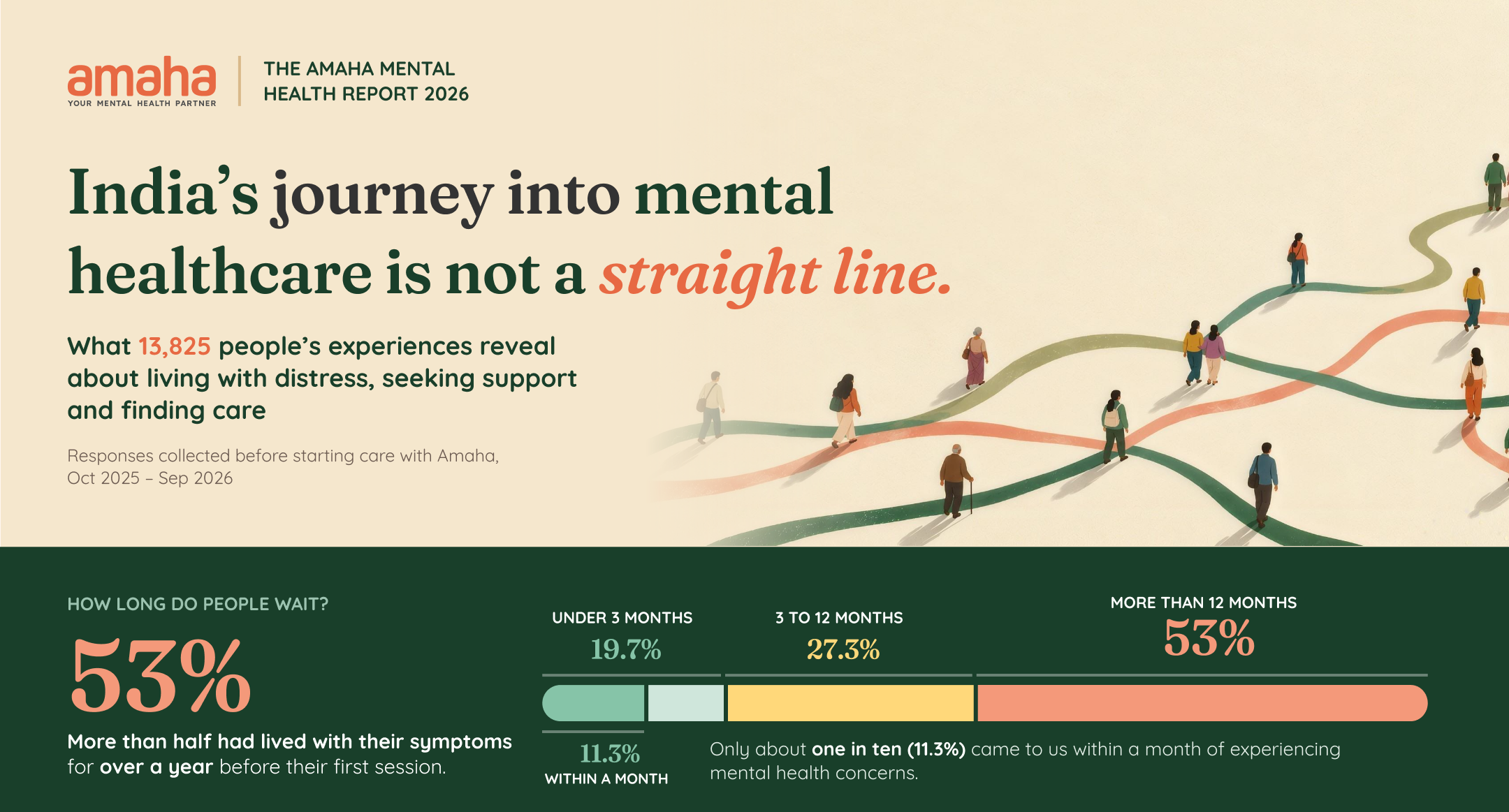
Mumbai, 14th October 2026: More than half (53%) of the people whose responses feature in Amaha’s Mental Health Report 2026 said they had lived with mental health concerns for over a year before seeking professional care. The report also found that 94.9% reported two or more concerns at once. The report, “The Amaha Mental Health Report 2026: Understanding the Journey to Care in India”, is based on responses from 13,825 people who answered questions before starting care with Amaha between October 2025 and September 2026. It looks at the time before someone begins formal care: who they turn to first, how they cope, and how long it takes them to reach a professional.
Dr. Amit Malik, Psychiatrist, Founder and CEO of Amaha, said: “India’s progress in mental health must be judged by whether people can get timely, effective care, not simply by how openly we talk about it. These are the accounts of people who reached us; they should make us ask who is still unable to access care. Friends, families, and communities are a vital part of the care ecosystem. They help people make sense of what they are experiencing, recognise the support they need, and help them find their way to care. Finding treatment should not become another test of a person’s resilience. The responsibility is ours to make that journey easier, and to bring clinicians, families, and communities together to support the person, with the person's own voice shaping decisions about their care.
Our ambition must go beyond delivering treatment to helping people return to work, rebuilding relationships, and living their best version possible, with greater independence. That is what progress should look like.”
A long wait before help
Only 11.3% reached care within a month of experiencing their concerns. In the meantime, people turned to what was close at hand: 54.5% had talked to friends or family and 44.6% had tried self-help. Many had also had some contact with care before. Nearly a third (32.9%) had tried therapy, and 19.4% had been prescribed medication.
How are people coping?
Alcohol and other harmful substances
15.4% of respondents reported using alcohol or other harmful substances before they accessed professional support. Men were more likely than women to report turning to alcohol or other harmful substances across every age group from 18 to 54, with the gap widening with age. Among 18–24-year-olds, the figures were 19.8% for men and 12.6% for women. Among 45–54-year-olds, they were 22.6% and 4.5%, respectively.
Other coping strategies
Avoidant coping strategies, such as excessive screen time, oversleeping, and overworking, were reported by 82.7% of respondents before they accessed care, while 43.1% reported adaptive strategies such as exercise or journaling. Respondents had the option of selecting more than one coping strategy.
Thoughts of self-harm
More than half of respondents (56.2%) said they had experienced thoughts of self-harm before seeking care. The figure was higher among students (71.7%) and unemployed people (64.7%) than among working professionals (53.2%).
These findings relate to people who had already taken the step of seeking care, so the figures should not be read as estimates for the overall Indian population.
When ‘just stress’ is something more
The words people first use for what they are feeling do not always match what a clinical assessment finds. In a subset of the cohort, 33% of those who described themselves as stressed were later diagnosed with depression, and 10% of those who named anxiety as a concern were diagnosed with ADHD. Among people who described repetitive thoughts and behaviours, 32% were diagnosed with depression and 11% with OCD.
This does not mean stress points to depression, or anxiety to ADHD. It means the first word someone uses for their distress is a starting point for an assessment, not a diagnosis.
Rarely just one concern
On average, people named five concerns each. Anxiety (72.1%) was the most common, followed by stress (67.5%), low mood (58.3%), relationship or interpersonal difficulties (55.6%) and frequent mood swings (54.1%). Some concerns tended to show up together: of those who reported sleep difficulties, 83% also reported anxiety.
By the time they reached care, many people were finding everyday life hard to manage. Only 12.3% said they could manage all their daily tasks, and more than a quarter (27.3%) could not manage most of them, or any at all.
Moving between therapy and psychiatry
About 7% of people who started with therapy went on to see a psychiatrist as well, while 20% of those who started with psychiatry also took up therapy. Among those who sought therapy after starting psychiatry, 93% did so within their first three psychiatry sessions.
Among people in psychiatric care, 56.9% showed improvement by their fourth session, as rated by clinicians on the Clinical Global Impression scale. This applies to psychiatry clients only and is not an overall recovery rate.
About Amaha
Founded in 2016 by psychiatrist and healthcare entrepreneur Dr. Amit Malik, Amaha is an integrated mental healthcare organisation offering services across digital self-care, outpatient and inpatient treatment, and community support. It provides evidence-based assessment and treatment for a range of mental health conditions, including anxiety, depression, bipolar disorder, ADHD, OCD, addiction, schizophrenia and personality disorders. Amaha operates nine centres across Bengaluru, Delhi NCR, and Mumbai, with services available in over 15 languages. It has delivered over 450,000 therapy and psychiatry sessions and served over 100,000 clients across 65 countries. Its clinical network comprises over 270 mental health professionals, and its peer support communities have over 65,000 members.
In 2022, Amaha joined hands with Children First, strengthening its services for children, adolescents and families. In 2025, it launched a 27-bed super-specialty mental health hospital in Bengaluru, expanding its capabilities in intensive psychiatric care. Amaha also partners with approximately 120 organisations to deliver workplace mental health programmes.
Company :-Storytellers 101
User :- Sonali Mishra
Email :-sonali@storytellers101.com



To ensure stability and reachability of your applications at all times, remote DDoS protection can keep your hosting services online
Get your Explainer Video at 100 dollars only Today.